Talk to someone, right now.
Talk to someone on Mindfuse. Free first conversation, anonymous, no appointment, no profile, no judgment. Just a real person on the other end.
Talk to a real person tonight.
Mindfuse connects you anonymously with a real person, anywhere on Earth, by voice. No profile. No performance. One free conversation a month.
How talking to someone on Mindfuse works
If you are feeling stuck in your own thoughts, it is time to have a real conversation with real people. Sometimes it is hard to find someone to talk to, and that is what Mindfuse is for: anonymous voice chats with random people from around the world.
Download and one-time verification
First, download Mindfuse from the App Store or Google Play and complete a quick phone number verification. That verification only confirms that every account belongs to a real person, and your number is never shared with anyone you talk to. There are no public profiles, follower counts, or personal information visible during conversations.
Matching and starting the call
Tap anywhere on the screen to start matching. Mindfuse connects you with another person who is online and looking for a conversation. It is completely random, with no swiping through profiles and no choosing people based on their appearance. Once a match is made, the conversation begins through voice only.
During the conversation
Conversations are one-to-one and voice only, so you can talk about whatever is on your mind. Whether you need to vent, work through something difficult, hear another person’s perspective, or simply enjoy an unexpected conversation, Mindfuse gives you the space to do that. Every conversation is natural, unscripted, and focused on genuine human connection.
Ending the call
When your conversation ends, that is simply where it ends. Mindfuse does not store chat history, record calls, or collect anything personal. Either person can end the call with a single tap. Whenever you feel like talking again, start another random anonymous online voice call.
Who Mindfuse is for (and who it isn't for)
Mindfuse is designed for everyday moments when talking to another person can make your day feel a little lighter. It is not designed to replace every form of support, and different situations call for different kinds of help.
There are moments when you do not need advice, a solution, or a professional. You just need to talk to someone about your problems, a real person who will listen. Maybe something happened today. Maybe your mind will not stop. Maybe you are carrying something you cannot say to anyone who knows you. The need to say it out loud, to another human being, is one of the oldest things about us.
The problem is rarely that no one cares. It is that the people you would normally call are asleep, or busy, or too close to the situation, or you simply do not want to become their problem tonight. So it stays inside, looping. That is exactly the gap Mindfuse was built for.
Talk to someone right now
If you need to talk to someone right now but there is no one to talk to, or if you do not want to talk to someone you already know, Mindfuse can connect you with a random stranger who is ready to have a conversation. Mindfuse is built for those moments when you find yourself thinking, "I need someone to talk to right now."
Everyday need to talk
Sometimes we are not facing any kind of crisis, we simply want someone who will listen to our thoughts or feelings. If you are feeling lonely, bored, emotionally exhausted, unable to sleep, or simply having a bad day, Mindfuse gives you the opportunity to have a genuine conversation with another real person.
Talk when friends or family are not available or not the right people
Even people in strong relationships sometimes struggle to talk openly about certain issues. We cannot always talk to our friends whenever we need to because they may be busy, asleep, or occupied with something else. Family members may unintentionally judge us or become worried. Speaking with a stranger often makes it easier to open up without worrying about future consequences.
Who should choose a different option
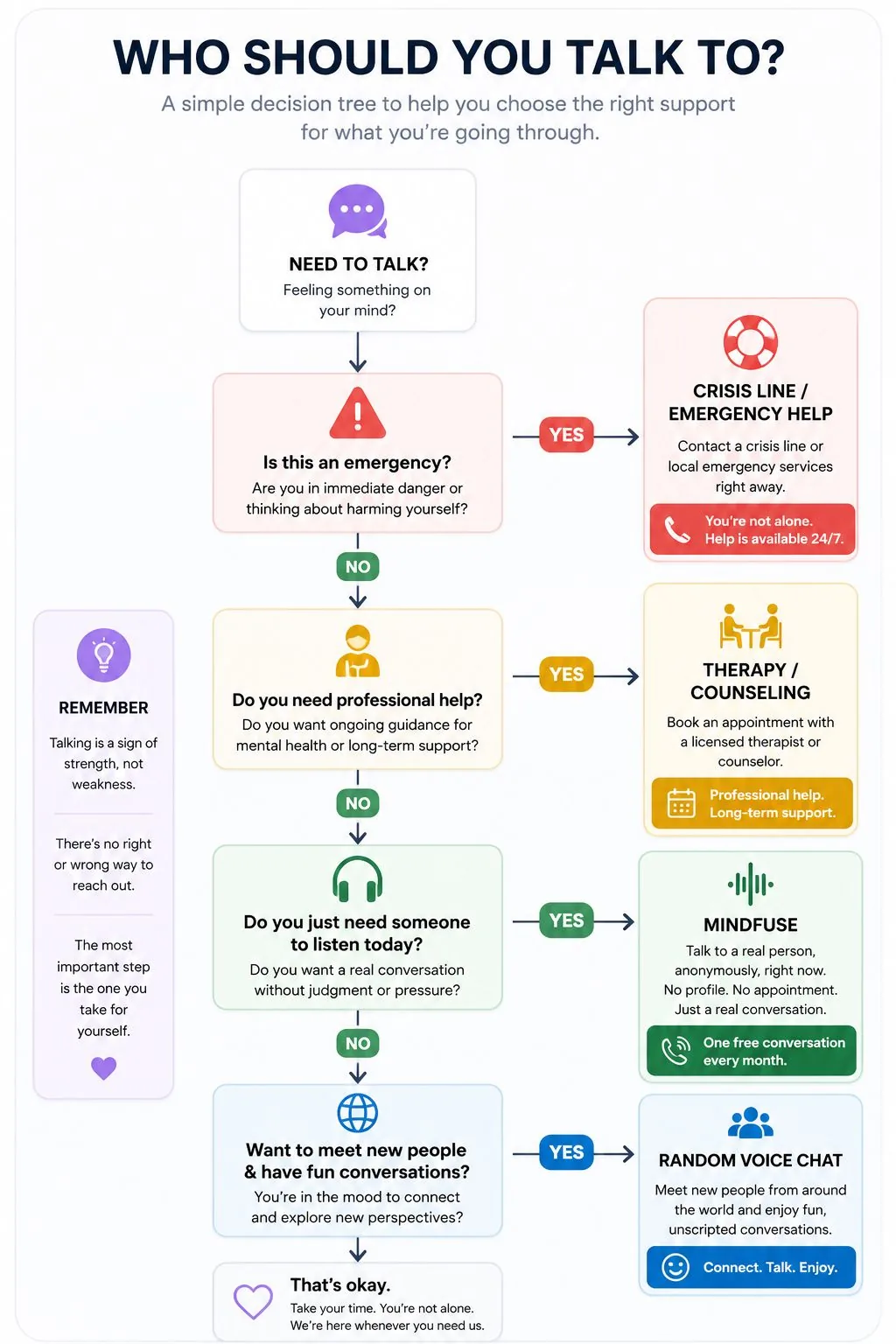
Mindfuse is not therapy, professional counselling, or emergency support. If you are experiencing a mental health crisis, thinking about harming yourself, or facing an emergency, please contact your local emergency services or a qualified professional who can provide the help you need. Mindfuse is designed for everyday conversations, not crisis situations.
Mindfuse vs other ways to talk to someone
There are many ways to talk to someone, and each serves a different purpose. Mindfuse fills the gap between texting people you already know and seeking professional help.
Friends and family
The people who know you understand your history, so their advice can be valuable. But many people avoid opening up because they do not want to worry or burden someone they care about. Talking to a complete stranger gives you the freedom to be completely honest without affecting your existing relationships.
Therapy or counseling
Therapists provide professional guidance for mental health and long-term growth. But there are moments when you simply need someone who will listen without waiting for an appointment or committing to ongoing sessions. Mindfuse is designed for those everyday conversations, not as a replacement for professional therapy.
AI chatbots
AI chatbots can give quick answers, but they cannot truly understand your emotions or share a real human experience. Hearing another person’s voice, laughter, empathy, and reactions creates a genuine human connection that AI cannot replace. If you are comparing different ways to vent anonymously, you can also explore the best venting apps available today.
Free random chat apps
Most free random chat apps are filled with bots, spam, fake accounts, and inappropriate behaviour. If you want to connect with a real person through voice chat, many of them simply fail to provide a good experience.
Warmlines and crisis lines
Warmlines and crisis lines provide an essential service for people in emotional distress or a mental health emergency. No online app can replace them. Mindfuse is for everyday conversations, not professional or emergency support.
| Option | Real human | Anonymous | Instant | No appointment | Voice |
|---|---|---|---|---|---|
| Mindfuse | Yes | Yes | Yes | Yes | Yes |
| Friend | Yes | No | Sometimes | Yes | Yes |
| Therapist | Yes | No | No | No | Yes |
| AI chatbot | No | Yes | Yes | Yes | No |
| Crisis line | Yes | Sometimes | Yes | Yes | Yes |
Common situations people use Mindfuse to talk
People use Mindfuse for many different reasons. Some are looking for advice, others simply want to hear another human voice after too long feeling lonely. There is no right or wrong reason to start a conversation.
After a hard day or argument
Some days leave you carrying more emotional weight than you realise. A difficult conversation at work, an argument, or a stressful day can stay on your mind for hours. Talking to someone can help organise your thoughts and make the situation feel more manageable.
When you feel overwhelmed
Not every problem has an immediate solution, but saying it out loud can make it feel much less overwhelming. Whether you are stressed, frustrated, or emotionally exhausted, having someone who listens without interruption can bring a real sense of relief.
Late at night when no one is awake
Loneliness often feels strongest after everyone else has gone to bed. Friends are offline, family are asleep, and messages go unanswered. In those moments, there is usually someone awake somewhere in the world who is ready to talk.
When you need to say something you cannot say to people who know you
Some thoughts feel too personal to share with friends, family, or colleagues because we worry about being judged. Mindfuse lets you speak openly with a complete stranger who has no connection to your everyday life.
When you simply feel the need for human contact
Sometimes we simply want to hear another person’s story, enjoy someone’s company during a quiet evening, or have an unscripted conversation that breaks the routine of everyday life.
Why talking to a real person helps
Humans process experience through language. Until you say something out loud, to another person, it tends to stay unresolved inside your head, compounding. The act of articulating what you are going through, even to a stranger, changes your relationship to it. You hear yourself say it, and a real person hears it with you, and something shifts.
You do not need a therapist for this. You need a person, someone present, listening, and not inside the situation with you. A stranger is often the easiest person to talk to, precisely because they have no history with you and no stake in your story. You can be completely honest.
What to expect in a conversation
Every person is different, so every conversation feels different. There is no script and no timer on Mindfuse, and no expectation that you need something important to say before you begin.
How most calls start
Most conversations begin the same way, with a simple "Hi," "Hello," "Where are you from?" or "How are you doing?" From there, the conversation naturally finds its own direction based on what both people feel comfortable discussing.
Listening vs talking
You do not have to carry every conversation alone. Sometimes you share your thoughts, sometimes you simply listen while someone else talks. Both are valuable parts of a meaningful conversation.
Simple ways to open
If you are not sure how to begin, ask where the other person is from, what brought them to the app today, or what they enjoy doing. Simple questions often lead to surprisingly meaningful conversations.
What the other person is usually there for
The other person tapped the same button you did. They may be looking for company, hoping to meet someone from another country, or simply wanting to express their feelings. Whatever brought them here, they also chose to spend some time talking to another human being.
Safety, boundaries, and what happens if it feels wrong
Feeling comfortable is essential for a good conversation, and Mindfuse is designed to give you control throughout.
Voice only and no profile
There are no profile photos, public accounts, or visible personal information. Every conversation happens through voice only, and no conversation history is saved.
One-tap exit
If you ever feel uncomfortable, you can leave immediately with a single tap. There is no obligation to stay, explain yourself, or keep talking.
Community guidelines
Every user agrees to community guidelines that encourage respectful conversations and genuine human connection. The goal is an environment where everyone feels comfortable talking to someone.
Why talking to a stranger can feel easier than talking to someone you know
Talking to a stranger often feels easier than talking to someone you already know because there is less pressure and fewer expectations. Conversations feel more open, honest, and free from judgement.
No shared history or future stakes
People who know you also know your past, and that history can make certain conversations difficult. A stranger has no expectations, no assumptions, and no role in your everyday life.
Freedom to be completely honest
You can be completely honest with a stranger without worrying about your reputation or future consequences. Many people find it easier to open up to someone they have never met than to someone they know personally.
Common questions
Is Mindfuse really free?
Your first conversation each month is free, no card needed. Want unlimited calls? Your first 2 weeks are free, then €4/month. The small fee is what keeps the community real: it filters out the bots and throwaway accounts that ruin free chat platforms.
Is Mindfuse completely anonymous?
Yes. The person you talk to never sees your name, photo, or any profile, they only hear your voice. You verify once with a phone number to prove you are a real person, but it is never shown to anyone. When the call ends, nothing is recorded or stored.
Is this therapy?
No. Mindfuse is not therapy and not a substitute for professional mental health support. If you are in crisis, please contact a professional or a crisis line. Mindfuse is for the everyday need to talk to a real person, the kind of conversation that used to happen naturally with friends, colleagues, and strangers.
Can I just listen on Mindfuse?
Meaningful conversations are usually two-way. You listen to someone else’s thoughts, and they listen to yours. That balance is what creates a genuine human conversation.
What if the conversation is awkward or unpleasant?
If a conversation feels awkward or uncomfortable, you can end the call immediately and start a new conversation with a completely different stranger.
Is anything recorded on Mindfuse?
No. Mindfuse does not record conversations, store call history, or keep personal information about your conversations.
What are the age requirements to use Mindfuse?
To use Mindfuse, you must be at least 18 years old.
Can the other person contact me later?
No. The other person does not receive any of your contact information and cannot contact you later unless you choose to share it yourself. Mindfuse encourages users not to share personal information during conversations.
Find what you are looking for
Explore more
Talk to someone tonight.
A real person, by voice, anonymously. One free conversation a month, no card needed.