Speak with native speakers
Talk to native speakers online, the part language learning apps skip
You can finish every lesson in an app and still freeze the moment a real person speaks to you. That gap closes one way only: by talking to native speakers, out loud, in real time. Using Mindfuse you can find them online, for any language, without flying anywhere.

One free conversation a month, no card needed. Then €4/month, cancel anytime.
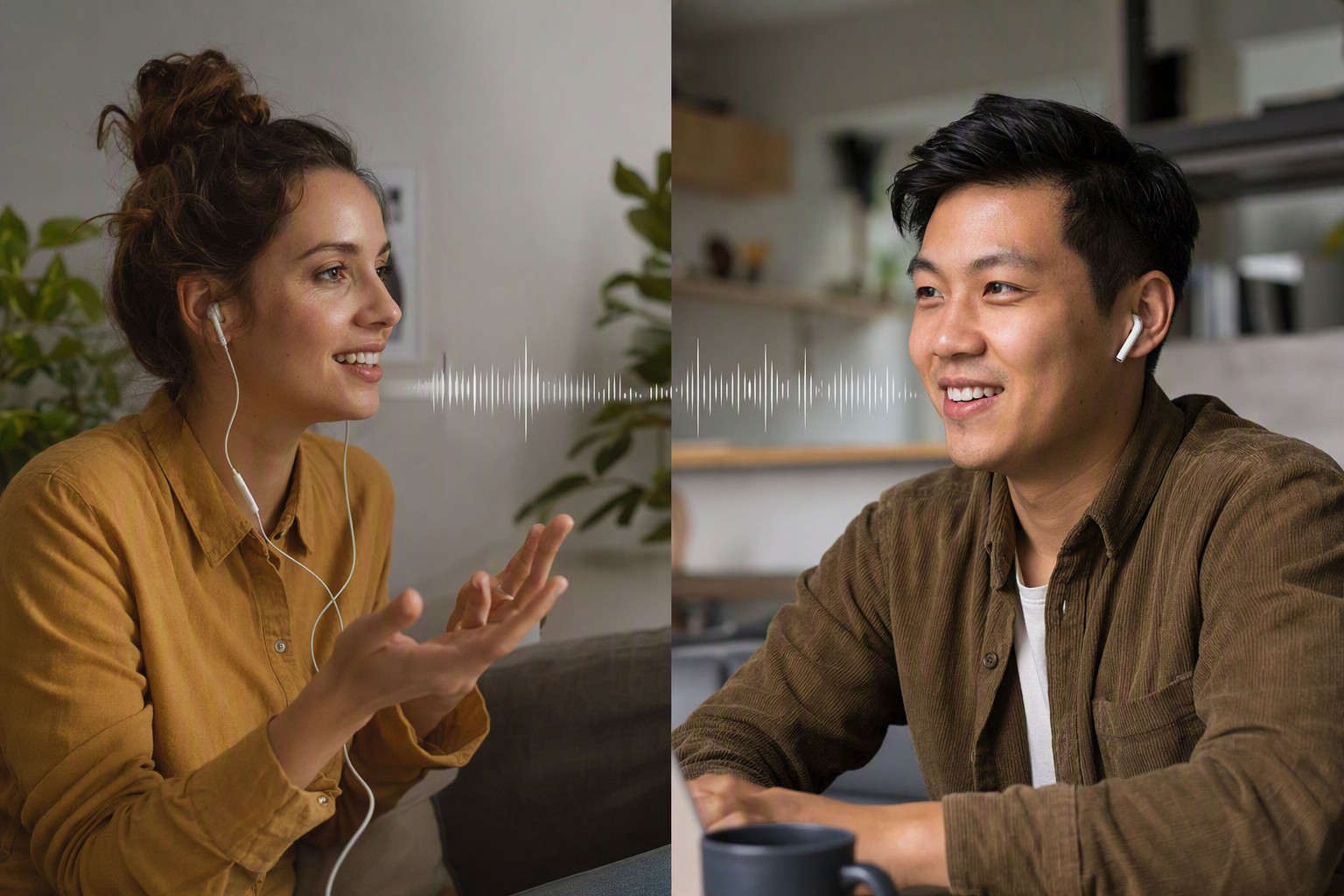
How to talk to native speakers online
There is no single best way to practise with a native speaker. The right option depends on whether you want a quick conversation, a regular partner, a teacher, or a place to practise without planning every session.
| If you want to... | Option | How it works |
|---|---|---|
| Start talking immediately | Mindfuse | Have a one-on-one voice conversation with a randomly matched person from around the world. |
| Find a regular language partner | Language exchange apps | Find people who speak your target language and want to practise your language in return. |
| Get corrections from a teacher | Online tutoring | Book one-on-one lessons with a tutor who can correct pronunciation, grammar, vocabulary, and speaking mistakes. |
| Practise with other learners and speakers | Conversation communities | Join voice or chat groups where people practise languages together. |
| Talk around a shared interest | Online communities | Join communities about gaming, films, travel, music, books, or other interests where native speakers participate. |
| Practise specific skills | Language practice platforms | Use platforms that combine speaking exercises, lessons, prompts, or other tools to practise a language more regularly. |
The methods, one by one
Mindfuse
Mindfuse is for people who want to start with a conversation instead of searching for a language partner first.
With Mindfuse you can have an anonymous one-on-one voice conversation with a randomly matched person from around the world. That means you can hear natural speech and practise responding in real time.
Language exchange apps
Language exchange apps are useful when you want to find someone who is learning your language while you practise theirs.
They can work well for regular practice because you can find people with similar language goals. The downside is that you may spend time messaging people, waiting for replies, and finding someone whose schedule actually matches yours.
Online tutoring
Online tutoring is the better choice when you want someone to teach, not just talk.
A tutor can plan lessons, correct repeated mistakes, explain grammar, and focus on a specific goal such as an exam, job interview, or pronunciation. Online tutoring costs more than casual conversation because you are paying for a person’s time and teaching.
Conversation communities
Conversation communities give you a place to practise with several people instead of relying on one language partner.
They can be useful when you want more speaking opportunities or enjoy group conversations. The downside is that you may get less one-on-one speaking time, especially when many people are talking at once.
Online communities
Online communities work best when you already have an interest that gives you something to talk about.
For example, joining a gaming community in your target language gives you a reason to speak beyond “let’s practise.” You can talk about the game, ask questions, and learn the language while discussing something you already enjoy.
Language practice platforms
These platforms are useful when you want more structure around your speaking practice.
You might get prompts, exercises, lessons, or other practice tools that help you prepare before speaking with real people. They are useful for building a routine, but they do not always replace the unpredictability of a real conversation.
Which platform is right for you?
| Your main goal | Look for |
|---|---|
| I want to talk right now | A voice platform like Mindfuse with quick access to real conversations |
| I want the same person regularly | A language exchange platform with partner discovery |
| I want someone to correct my mistakes | A tutor or teacher |
| I want casual speaking practice | Voice or conversation communities |
| I want to talk about my hobbies | Interest-based online communities |
| I want lessons before conversation | A structured language practice platform |
| I want to hear different accents | A platform with many speakers from different places |
| I hate writing long messages before talking | A voice-first service |
Why Mindfuse is useful for talking to native speakers
Mindfuse is useful when you need more real speaking practice without turning every conversation into a formal lesson.
Mindfuse connects you to a person by voice, so you have to listen and respond in real time. There is no long text exchange where you can spend five minutes checking every sentence before sending it.
The important limitation is that Mindfuse uses random global matching. You cannot choose a specific native speaker or guarantee that the next person speaks the language you are practising.
What to expect when talking to native speakers online
- You may understand less than you expect: native speakers do not always speak like the audio in a beginner lesson.
- People speak at different speeds: some will speak slowly, while others may speak quickly or use shortened words.
- Accents will vary: two native speakers of the same language can sound very different.
- You will not know every word: that is normal, especially when the conversation moves away from familiar topics.
- You may make mistakes: speaking practice is where you find the words and grammar you still struggle to use.
- The conversation may go somewhere unexpected: a simple question about food can turn into a conversation about travel, work, family, or music.
- The first conversation may feel difficult: understanding a real person takes practice, especially when you are used to controlled learning material.
- Not every native speaker is a good practice partner: speaking the language natively does not automatically mean they are good at teaching it.
- You may learn informal language: real conversations can include slang, filler words, shortened expressions, and phrases that textbooks rarely use.
- Your goal is not to understand every word: focus first on understanding the main idea and keeping the conversation moving.
Why native speakers specifically
An app teaches you about a language. A native speaker teaches you the language.
Real speech is full of things no course covers: the speed people actually talk at, the slang, the filler words, the way a sentence gets abandoned halfway and restarted. Native speakers give you the unscripted version, and, just as importantly, instant feedback. You say something slightly wrong, they react, and you adjust in the moment. That loop is how speaking ability is actually built.
It also fixes the thing apps can’t: the fear. The more low-stakes conversations you have, the less your heart races when it counts. Confidence is just reps.
Why voice beats text exchange
Most “language exchange” ends up being texting. Texting is not speaking.
When you type, you get unlimited time to look up words and fix grammar. That feels productive, but it trains the wrong muscle. Speaking is real-time: you have to produce the language now, hear it now, and respond now. Only voice practice trains that. If your goal is to actually speak, you need conversations that happen at the speed of speech.
That is exactly what Mindfuse is: anonymous, one-on-one voice calls with real people around the world. No profiles to maintain, no text threads that fizzle out, just a voice on the other end. One free conversation a month, no card needed. Then €4/month, cancel anytime.
Common problems when practising with native speakers
- You understand lessons but struggle with real speech: practise with different speakers instead of listening to only one familiar voice.
- The other person speaks too fast: ask them to slow down or repeat the sentence.
- You keep forgetting words: explain the idea using easier words instead of stopping completely.
- The conversation becomes one-sided: ask questions, share your own answers, and give the other person something to respond to.
- You spend more time texting than speaking: choose a voice-based option when speaking is your actual goal.
- Your partner keeps correcting everything: ask for corrections on mistakes that affect meaning or mistakes you repeatedly make.
- You run out of things to say: keep a few simple topics ready, such as food, work, travel, hobbies, films, or daily life.
- You cannot find a regular partner: try several people or use a platform designed for partner matching.
- You only practise with people at your level: occasionally talk with stronger speakers so you get used to more natural language.
- You expect every conversation to teach you something new: some conversations will be ordinary, and that is still useful speaking practice.
- You focus too much on perfect grammar: communication comes first; note repeated mistakes and work on them after the conversation.
How to be safe when talking to native speakers online
- Treat every new person as a stranger.
- Do not share sensitive information.
- Be careful with money requests.
- Do not open suspicious links or files.
- You can leave a conversation.
- Set your own boundaries.
- Do not assume identity from a profile or conversation.
- Use the platform’s available safety controls when necessary.
How do I find native speakers to talk to online?
Voice apps that match you with people globally are the simplest route, you get a real speaker on the line without arranging anything. Mindfuse connects you one-on-one by voice with people worldwide; you simply start talking.
Is talking to a native speaker better than using a language-learning app?
They solve different problems. A learning app can give you structure and repetition, while a real conversation makes you use the language when you do not already know exactly what the next sentence will be.
Is it free to practice with native speakers?
You can start for free: Mindfuse gives you one conversation a month at no cost, no card needed, then it is €4/month for unlimited calls, cancel anytime. That is far cheaper than tutoring, and the practice is unscripted and real.
I am a total beginner, is talking to a native speaker too early?
No. Even short, simple exchanges build your ear and your confidence faster than silent study. Start with basics, let the other person carry some of it, and you will improve every session.
What should I do if I cannot understand a native speaker?
Ask them to repeat or slow down, then focus on the main idea rather than every individual word. If the speaker uses an unfamiliar expression, ask what it means and continue the conversation.
Which languages can I practice?
Because matches are global, you can encounter speakers of many languages. The more you use it, the more variety of speakers, and accents, you are exposed to.
How long should I talk to a native speaker each time?
There is no magic number. A short conversation that makes you listen and respond in real time is useful, and regular practice matters more than forcing yourself into very long sessions.
Stop studying the language. Start speaking it.
Mindfuse puts a real person on the line, by voice, from anywhere in the world. One free conversation a month, no card needed. Then €4/month, cancel anytime.
Start talking nowAnonymous, voice only. Real people, not AI.